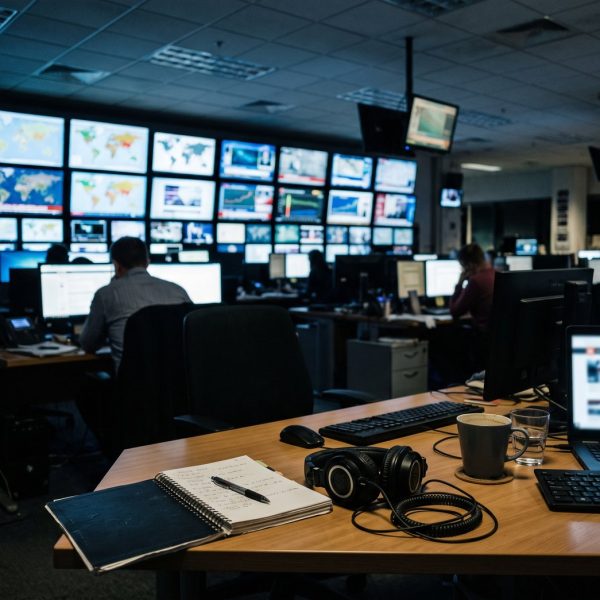
A wire story lands in a newsroom at 2am local time, sourced from a regional outlet in Kharkiv or a ministry briefing in Moscow, and an editor has maybe twenty minutes to decide whether it runs. Nobody on the desk speaks the source language fluently. What happens next says a lot about how seriously a newsroom treats accuracy versus speed.
Wire services and international desks quietly rely on translation infrastructure most readers never think about. When that infrastructure breaks down, corrections follow days later, after the wrong quote has already been shared thousands of times.
Why Newsroom Translation Is Different From Business Translation
A contract translator has time to check terminology against a glossary. A newsroom does not. Breaking coverage of a fast-moving story out of Russia or Ukraine often means a translator is working from a video transcript, a social media post, or a garbled phone line, with an editor waiting on the other end of a Slack message.
Speed pressure is exactly where mistranslation risk is highest. A single misread verb tense in a government statement can change whether a story reads as a threat or a routine update, and that difference matters enormously when the story is about an active conflict zone or a diplomatic negotiation.
What Separates a Reliable Wire Translator From a Risky One
- Experience with journalistic register, not just literal accuracy, since tone shifts meaning in political reporting.
- Familiarity with regional dialects and administrative terminology specific to the source country.
- A track record of fast turnaround without skipping a second read on anything quote-worthy.
Russian Sources Bring Their Own Layer of Difficulty
Government statements, court filings, and state media releases in Russian often use formal bureaucratic phrasing that does not translate cleanly into plain English news copy. A newsroom relying on english russian translation support needs translators who can flag ambiguity rather than smoothing it over, since a smoothed-over ambiguity in a diplomatic cable can turn into a factual error in print.
Sanctions announcements and legal filings are especially prone to this problem. Legal Russian carries technical distinctions that a general-purpose translator can miss entirely, turning a conditional clause into what reads like a definite statement.
Ukrainian Coverage Requires a Separate Set of Specialists
Since 2014, and especially since 2022, Ukrainian-language sourcing has become central to conflict reporting, and treating it as a Russian-adjacent language is a mistake many desks still make. A dedicated ukrainian to english translator catches nuances that a Russian specialist working across languages frequently misses, particularly in military terminology that has evolved rapidly over the past several years.
Regional dialect variation inside Ukraine adds another layer. A source quote from Lviv and one from Kharkiv can carry different regional phrasing, and a translator unfamiliar with that range risks flattening distinct voices into generic wire copy.
A Quick Checklist Before Running a Translated Quote
- Has the quote been checked against the original audio or document, not just a prior translation?
- Does the translator understand the political context well enough to flag ambiguous phrasing?
- Is there a second reviewer for anything that will run as a direct quote rather than paraphrase?
Consistency Across a Long-Running Story
Conflict coverage often runs for years, and outlets that cover it well maintain consistent terminology across hundreds of articles. A newsroom asking cat translation tool questions partway through a long-running beat has usually already accumulated inconsistent spellings of place names, ranks, and institutions across its archive.
A shared translation memory keeps a contested place name spelled the same way in January and in December, which matters for search, for archive coherence, and for the outlet's credibility with readers who notice inconsistency.
Verifying sources across languages is slow, careful work that does not scale by adding urgency. Companies publishing at volume run into the same limit, which is why a content writing agency is often brought in to carry routine output while specialists handle the sensitive material. Dividing the work that way protects both quality and pace.
Newsrooms working with Russian and Ukrainian sources have to verify claims that no reporter on the ground can check directly. Humanitarian details are often the easiest to confirm, because hospitals and aid agencies keep records that outlast the news cycle. Reports on wartime blood donation drives, for instance, can be cross-checked against transfusion service figures rather than taken on trust.
Reporting on Russian and Ukrainian sources demands nuance that machine translation cannot deliver. A specialist translation agency provides native linguists who catch tone, context, and political subtext. Newsrooms that invest in that expertise publish stories their audiences can trust.
Training Junior Editors to Spot Translation Risk
Most journalism programs teach source verification, but few spend meaningful time on how to work with a translated source. Junior editors are often handed a translated quote and told to run with it, without ever learning what questions to ask the translator first.
Newsrooms that invest in this training tend to catch problems earlier, before a questionable translation reaches publication. A junior editor who knows to ask whether a phrase has multiple plausible readings is far more useful on a fast-moving desk than one who simply accepts the first version handed to them.
This matters even more on stories involving legal or military terminology, where a single term can carry very different weight depending on which translation choice a wire service made months earlier and never revisited.
The Cost of Getting It Wrong
A mistranslated headline spreads faster than its correction ever will. Outlets that have built reliable Russian and Ukrainian translation pipelines are not just protecting accuracy for its own sake, they are protecting themselves from the reputational damage that follows a viral correction.
For readers interested in how translation shapes international reporting more broadly, the Wikipedia overview of news agencies offers useful context on how wire services built their translation infrastructure over the past century.
Newsrooms rarely get credit for translation done well, since the whole point is that readers never notice it. They get plenty of attention when it goes wrong, which is exactly why the quiet infrastructure behind a wire story deserves more investment than it typically gets.